INQUIRY

Manufacturing

1 Stainless Steel
Stainless Steel Manufacturing Process

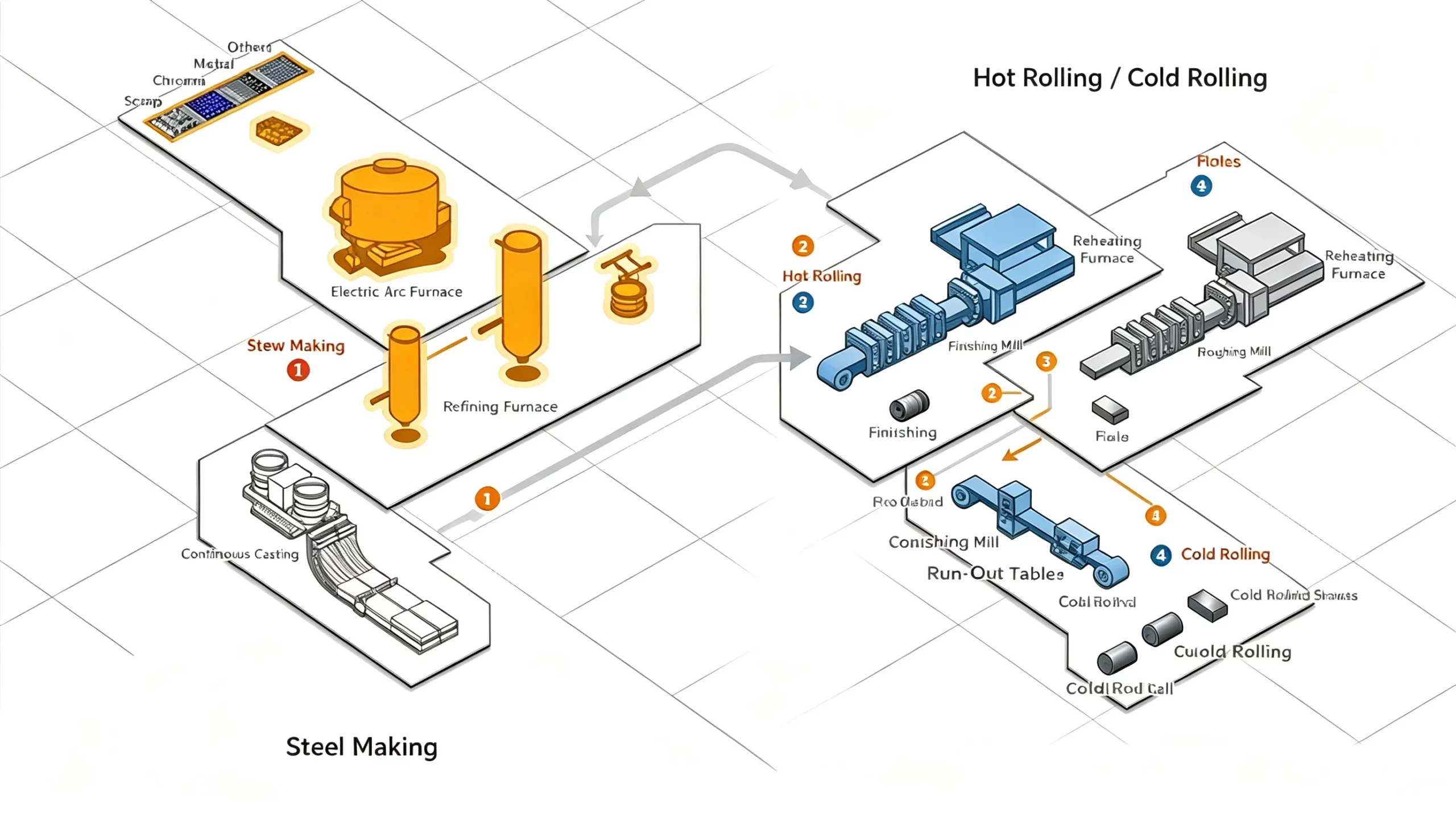
  1. Steel making:Steel making is the critical process that determines the quality, performance, and cost competitiveness of steel products. SHOUYUAN is equipped with advanced AOD (Argon Oxygen Decarburization), VOD (Vacuum Oxygen Decarburization) and continuous casting facilities, enabling precise control of steel composition and superior product quality.
  2. Hot Rolling:Slabs produced in the steel making plant are processed through hot rolling to form black coils with precisely controlled thickness, shape, and mechanical properties. Through advanced heat treatment, pickling, and finishing processes in the annealing and pickling line, black coils are transformed into high-quality white coils tailored to customer requirements. These products serve as premium raw materials for cold rolling, pipe manufacturing, and sheet production.
  3. Plates:Steel slabs from the steel making process under go advanced rolling, heat treatment, and pickling procedures before being cut into customized sizes according to customer specifications. SHOUYUAN’s heavy plates feature excellent strength, durability, and corrosion resistance, making them widely used in demanding industries including petrochemicals, power generation, paper manufacturing, and specialized shipbuilding.
  4. Cold Rolling:SHOUYUAN operates advanced cold rolling facilities equipped with 20-high cluster mills, bright annealing lines, TLL (Tension Leveling Line), AFC (Automatic Flatness Control), and AGC (Automatic Gauge Control) systems. These technologies ensure high precision and consistent quality in cold-rolled products, with thicknesses ranging from 0.1 mm to 3.0 mm and widths of up to 1,580 mm, available in various surface finishes and customized specifications.
2 Hot Rolled Steel
Hot Rolled Steel Manufacturing Process

  1. Reheating and Descaling
    Hot-rolled coils undergo a comprehensive pickling process, where high-performance scale breakers and hydrochloric acid solutions effectively remove surface scale and oxide layers. This process eliminates potential surface defects and ensures a clean, uniform surface for subsequent cold rolling operations.
  2. Rough Rolling
    During the rough rolling stage, descaled slabs are processed into intermediate strips with precisely controlled shape, thickness, and width. Equipped with advanced Automatic Width Control (AWC) technology, the roughing mill’s entry and exit edgers accurately regulate strip width, ensuring dimensional consistency and stable product quality throughout the rolling process.
  3. Finishing Rolling
    The finishing rolling process precisely adjusts the thickness, width, and profile of steel coils to meet specified customer requirements while achieving excellent surface quality and dimensional accuracy at the targeted finishing temperature. SHOUYUAN utilizes advanced equipment, including Work Roll Shift Mills, Pair Cross Mills, and On-line Roll Grinders (ORG), to optimize productivity, improve strip shape control, and enhance the overall quality of finished coils through precise crown control technology.
  4. Run-Out Table Cooling and Coiling
    After passing through the finishing mill, steel strips are transported onto the run-out table for controlled cooling and coiling. Through optimized water-cooling technology, the strips are rapidly cooled to the appropriate coiling temperature, ensuring stable metallurgical properties and consistent coil quality.
3 Cold Rolled Steel.
Cold Rolled Steel Manufacturing Process

  1. Pickling
    Hot-rolled coils undergo an advanced pickling process, where scale breakers and hydrochloric acid solutions effectively remove surface scale and oxide layers. This process ensures a clean and uniform surface by eliminating potential defects, providing an optimal foundation for subsequent cold rolling operations.
  2. Cold Rolling
    After pickling, steel coils are processed through high-precision tandem cold rolling mills to achieve the required thickness, typically reducing the original material thickness by 40%–90%. Advanced automated process control systems enable precise shape adjustment, superior dimensional accuracy, and consistent product quality.
  3. Electrolytic Cleaning
    Electrolytic cleaning is applied to remove residual rolling lubricants, oils, and surface contaminants from cold-rolled steel. This ensures a clean surface condition and prepares the material for the subsequent annealing process.
  4. Annealing
    Annealing is a critical heat treatment process that restores the steel’s mechanical properties and enhances its formability. Through advanced batch annealing and continuous annealing technologies, SHOUYUAN produces cold-rolled steel products with excellent deep-drawing performance, high tensile strength, and superior surface quality.
  5. Skin Pass Rolling
    As the final finishing process, skin pass rolling improves surface quality, flatness, and mechanical properties by eliminating minor surface imperfections such as stretch marks. This process produces a smooth, bright, and uniform surface finish while achieving an additional thickness reduction of approximately 1%.
1 Galvanized Steel
Galvanized Steel Manufacturing Process

1. Pre-Treatment Process:During the pre-treatment stage, residual rolling oils, surface contaminants, and impurities on cold-rolled steel sheets are thoroughly removed. The sheets are passed through an alkaline cleaning solution under an electrically charged condition, generating an electrochemical reaction that ensures a clean and highly active surface for subsequent coating processes.

2. Annealing:The annealing process modifies and enhances the mechanical properties of pre-treated steel sheets through controlled recrystallization. This process improves material strength, ductility, and formability, providing the optimal metallurgical structure required for high-quality galvanized steel production.

3. Hot-Dip Galvanizing:After annealing, steel sheets pass through a molten zinc bath where a uniform zinc coating is applied to the surface. The coating thickness and weight are precisely controlled by removing excess zinc with a high-pressure air knife before solidification, ensuring consistent coating performance and excellent corrosion resistance.

4. Galvannealing:Following hot-dip galvanizing, the coated steel sheet undergoes a controlled reheating process to promote the diffusion of zinc atoms into the iron substrate. This forms a zinc-iron (Zn-Fe) alloy coating with enhanced weldability, paintability, and corrosion resistance, making it particularly suitable for demanding applications such as automotive manufacturing.

5. Skin Pass Mill (SPM) & Chemical Treatment:To achieve superior flatness, surface quality, and an attractive finish, galvanized steel sheets undergo skin pass rolling. A chrome-free chemical treatment is then applied to the surface to prevent white rust formation on activated zinc coatings while further improving corrosion resistance and long-term durability.

6. Inspection & Coiling:After surface treatment, galvanized steel sheets undergo comprehensive quality inspection to ensure compliance with strict requirements for surface appearance, coating uniformity, mechanical properties, and dimensional accuracy. Qualified products are then carefully coiled and prepared for shipment to customers.