INQUIRY

You are here :

☰ALL CATEGORIES

Shop

301 stainless steel is a common austenitic stainless steel accommodating 17 percent chromium and 7 percent nickel, giving it extra strength and ductility when cold worked. What is more, it has amazing corrosion resistance properties.
310S stainless steel has incredible oxidation resistance and corrosion resistance as an austenitic chromium-nickel stainless steel. Because of a higher percentage of chromium and nickel, so that it possesses better creep strength as well as high temperature resistance.
316 stainless steel has extra 2-3% molybdenum, in addition to iron, chromium and nickel. Molybdenum significantly leads to better performance of 316 stainless steel in certain corrosive environments containing chlorides. So it is a very common choice in situations requiring higher corrosion resistance.
316L stainless steel, similar to 316 stainless steel, has a lower amount of carbon of no more than 0.03% in its composition. This is meant to reduce the risk of carbon precipitation, to make a better choice for welding to achieve maximum corrosion resistance.
430 stainless steel has always been a popular material for a variety of applications for its durability and corrosion resistance. However, welding 430 stainless steel can be challenging due to its high chromium content.
316 stainless steel contains 2-3% molybdenum, aside from iron, chromium and nickel. The addition of molybdenum significantly improves the performance of 316 stainless steel in certain corrosive environments, especially those containing chlorides. 316 stainless steel is more commonly used when higher corrosion resistance is needed.
430 stainless steel is a very practical material for a variety of applications due to its durability and corrosion resistance. However, high chromium content makes it more difficult to perform welding jobs for 430 stainless steel.
304L stainless steel has a very similar chemical composition to 304 stainless steel with one key difference. The maximum carbon content is set at 0.08% for 304, whereas grade 304L stainless steel has a maximum carbon content of 0.03%. It is more often adopted in the production of equipment and parts that require better corrosion resistance.
310S stainless steel is austenitic chromium-nickel stainless steel, with good oxidation resistance, corrosion resistance, because of a higher percentage of chromium and nickel, it has better creep strength, can work at high temperatures continuously, with good high temperature resistance.
321 stainless steel is an austenitic stainless steel that has excellent corrosion resistance at room temperature, aside from high-temperature strength and creep resistance.
321 stainless steel is an austenitic stainless steel that has excellent corrosion resistance at room temperature, as well as good high-temperature strength and creep resistance.
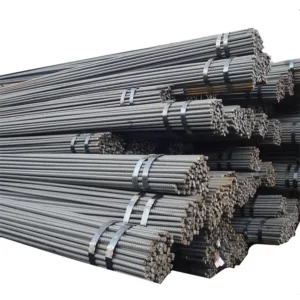
Deformed bar, also known as rebar (short for reinforcing bar), is a steel bar or mesh of steel wires used as tension devices in reinforced concrete and reinforced masonry structures to strengthen and hold the concrete in tension. Deformed bar’s surface is often patterned to form a better bond with the concrete.